


What equipment is used in spray drying?
 Aug 29, 2025|
 View:1189
Spray drying is a highly efficient drying technology, which can quickly convert liquid materials into dry powders and is widely used in food, pharmaceutical, chemical, ceramic and other industries. Its core equipment is the Spray Drying Machine, through a series of precision components work together to achieve efficient, uniform Drying process. This article will use easy-to-understand language, all-round analysis of spray drying equipment composition, function and application to help you fully understand this technology.
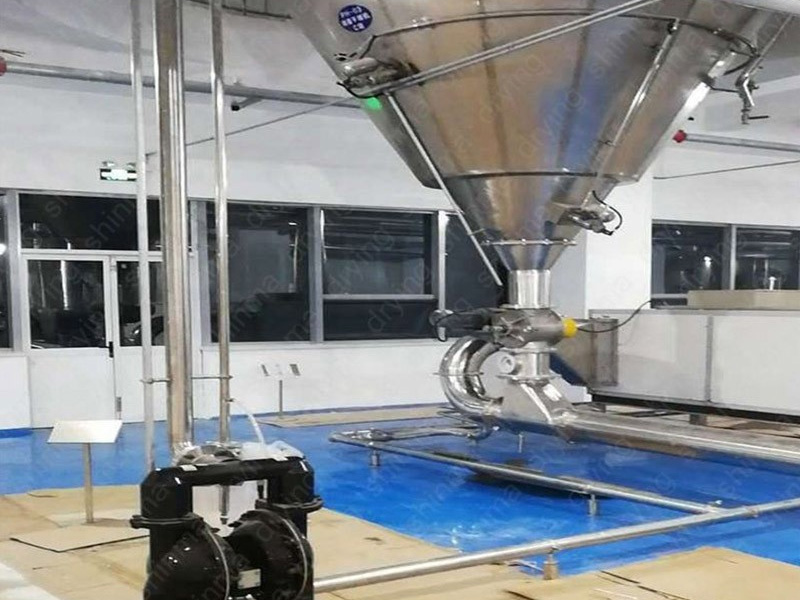
Basic composition of spray drying equipment
Spray drying equipment is an integrated system, mainly composed of the following core components:
Feeding system
The feeding system is responsible for conveying the liquid material to be dried (such as solution, suspension or emulsion) to the atomizer. It includes a storage tank, a transfer pump, and a filter. Storage tanks are used to store material, transfer pumps (usually peristaltic or centrifugal) ensure a steady flow of material, and filters remove impurities that may clog the nebulizer. The stability of the system directly affects the drying effect.
Nebulizer
Atomizer is the“Heart” of spray dryer, its role is to disperse the liquid material into very fine droplets (usually 10-200 microns in diameter) , to increase the surface area, accelerate water evaporation. Common types of nebulizers include:
Pressure Nebulizer: high-pressure pump through the liquid forced through the tiny nozzle, the formation of fog. Suitable for low viscosity materials, such as fruit juice or dyes.
Centrifugal atomizers: high-speed spinning disks (up to 10,000-30,000 rpm) produce centrifugal force that tears the liquid into droplets. Suitable for high viscosity or granular materials, such as ceramic slurry.
Air Nebulizer: uses a Compressed air to blow liquid into a mist, suitable for heat sensitive materials or small-scale laboratory production.
Drying room
The drying chamber is a large chamber (usually made of stainless steel) where the atomized droplets come into contact with hot air and the moisture evaporates rapidly. Drying chamber design is mostly cylindrical or conical, smooth interior to prevent wall sticking powder. The flow mode of hot air and droplets can be divided into cocurrent flow, countercurrent flow or mixed flow, among which cocurrent flow (hot air and droplets moving in the same direction) is the most commonly used, which is suitable for heat-sensitive materials.
Heating system
Heating systems provide the heat needed for drying, usually using an electric, steam, or gas heater to heat the air to 100-300 °C. Hot air through the fan into the drying chamber, its temperature and flow can be accurately controlled to meet the needs of different materials drying.
Powder collection system
The dried powder should be separated from the air and collected. Commonly used equipment includes:
Cyclone separator: the use of centrifugal force will be most of the powder from the exhaust gas separation, simple structure and high efficiency.
Bag Filter: the fine powder is collected by fiber filter bag (the recovery rate can reach more than 99%) , which is suitable for high value products such as pharmaceuticals.
Wet Scrubber: use water to wash off-gas. It is suitable for the occasion with environmental protection requirement.
Exhaust system
The exhaust system, which consists of an induced draft fan and a chimney, discharges moist air and exhaust gases into the atmosphere. Modern equipment is often equipped with environmentally friendly devices (e.g. dust collectors or condensers) to ensure compliance with discharge standards.
Auxiliary equipment and intelligent control
In order to improve production efficiency and safety, spray drying equipment is often equipped with the following auxiliary systems:
Control system: modern spray dryer adopts PLC (Programmable logic controller) or computer control, automatic adjustment of temperature, pressure and flow parameters. The user can monitor the running state in real time through the touch screen to ensure stable operation and energy saving.
Cooling device: for rapid cooling of dried powder to prevent denaturation of heat-sensitive materials such as proteins or probiotics. Common designs include fluid bed cooling or jacket cooling.
Cleaning system (CIP) : provide on-site cleaning function, through the sprinkler automatic cleaning equipment, reduce labor maintenance costs, especially suitable for the food and pharmaceutical industry.
Application advantages and points for attention
The main advantages of spray drying equipment are:
Efficient and fast: drying process only seconds to dozens of seconds, suitable for continuous mass production.
High quality: the powder has uniform particle size, good fluidity, and can retain the active ingredients of the material (such as vitamins or enzymes) .
Flexibility: can adjust the parameters (such as temperature or atomization way) to adapt to different materials.
However, the following points should be noted:
High energy consumption: the heating system needs to consume a lot of energy, need to optimize the design to reduce costs.
Material Adaptability: some high viscosity or easy oxidation of materials may need pretreatment (such as concentration or add drying agent) .
Equipment Maintenance: regularly clean the atomizer and drying chamber to prevent clogging or contamination.
Examples of industrial application
Spray drying equipment plays an important role in a number of areas:
Food Industry: for the production of milk powder, coffee powder, seasoning, etc. , to retain flavor and nutrition.
Pharmaceutical industry: Preparation of antibiotics, vaccines or traditional Chinese medicine extracts to ensure product purity and solubility.
Chemical industry: production of ceramic powder, dyes or polymers to improve product stability.
Conclusion
Spray drying equipment is a complex but efficient integrated system, the core of which includes feeding system, atomizer, drying chamber, heating system and powder collection system. Through intelligent control and auxiliary equipment, it can meet the drying needs of a variety of industries. Selecting reliable spray dryer manufacturers, such as Shinma, with their advanced technology and quality service, can provide you with customized solutions to ensure production efficiency and product quality. If you have related requirements, it is recommended to consult a professional manufacturer for more detailed guidance.


Recommended Products

Hollow paddle dryer equipment

Spray Dryer Machine Chemical Drying Equipment

High Pressure Pump Spray Dryer Machine

Max Speed 18000r/min Centrifugal Spray Dryer Machine

LPG High Speed Centrifugal Spray Dryer Equipment

ZLPG Spray Dryer For Chinese Traditional Medicine Extract

Industrial Spray Drying Machine For Tannic Acid

Coconut Milk Powder Spray Dryer Machine

Instant Coffee Spray Dryer丨Food Processing Pressure Nozzle Spray Dryer Equipment

Congeal Chemical Pressure Spray Dryer 15kg/H Customized Size


Recent News
1.Shinma's Fluidized Bed Granulator: Advancing Small-Molecule Peptide Granulation
2025-08-132.How does a vacuum belt dryer work?
2025-07-313.Spray Drying Instant Coffee: A Business Owner’s Guide to Efficiency and Profitability
2025-07-184.38kg/H Hydrolyzed Fish Protein Fish Drying Equipment Industrial Dehydrator Machine
2025-05-07

