


How to Use a Spray Dryer to Make Milk Powder
 Aug 25, 2026|
 View:2788
When it comes to producing milk powder, the spray drying process is the key technology used by dairy manufacturers to convert liquid milk or concentrated milk into a fine, stable powder. But how exactly does a milk powder spray dryer work, and what factors determine the quality of the final product?
A milk powder spray dryer does much more than simply expose milk to hot air. Successful milk powder production requires the right combination of milk preparation, concentration, atomization, temperature control, airflow management, powder separation, and downstream processing.
In this guide, we'll explain how to use a spray dryer to make milk powder step by step. We'll also cover the complete milk powder production process, key spray drying parameters, atomization methods, equipment selection, common production problems, and the factors that dairy manufacturers should consider when choosing an industrial milk powder spray dryer.

What is Spray Drying?
Spray drying is a widely used method for producing milk powder from liquid milk or concentrated dairy feed. It is a process that converts a liquid into a dry powder by atomizing the feed into very small droplets and bringing those droplets into contact with a controlled stream of hot air.
As moisture evaporates rapidly from the droplets, the milk solids remain and form dry particles. The finished powder is then separated from the exhaust air and collected for cooling, further processing, or packaging.
The basic spray drying process includes:
Feed preparation
Atomization
Contact with heated drying air
Rapid moisture evaporation
Powder separation and collection
The process is continuous and can be designed for different production capacities and dairy products.
Spray drying is commonly used for:
Whole milk powder
Skim milk powder
Whey powder
Dairy ingredients
Nutritional powders
Protein powders
Infant formula ingredients
Other liquid or emulsified food products
The fast drying process makes spray drying particularly suitable for large-scale powder production.
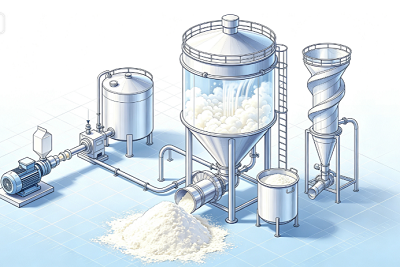
Why Choose a Spray Dryer for Milk Powder Production?
Before diving into the steps of how to use a spray dryer, let's first answer a simple question: why is a spray dryer the preferred choice for making milk powder?
1. High Production Efficiency
Spray dryers are designed for continuous production and can process large volumes of liquid feed efficiently. By converting liquid milk into fine droplets, the equipment creates a large surface area for rapid evaporation.
This makes industrial spray drying suitable for dairy plants that require consistent, high-volume production.
2. Good Product Quality and Consistency
When process conditions are properly controlled, spray drying can help manufacturers produce milk powder with consistent moisture content, particle characteristics, and handling properties.
Important factors include:
Feed solids content
Feed viscosity
Atomization quality
Inlet and outlet air conditions
Airflow pattern
Residence time
Powder collection efficiency
3. Efficient Water Removal
Removing water from milk before and during drying significantly reduces product weight and volume. This makes the final powder easier to store, transport, and distribute than liquid milk.
In industrial production, milk is commonly concentrated before spray drying to reduce the amount of water that must be removed inside the drying chamber.
4. Continuous and Scalable Production
A milk powder spray dryer can be designed according to different production requirements, from pilot-scale testing to large industrial dairy production lines.
The system can also be integrated with:
Evaporation equipment
Feed tanks and pumps
Fluid bed dryers
Cyclone separators
Bag filters
Powder conveying systems
Cooling systems
Automatic packaging equipment
This flexibility makes spray drying suitable for modern dairy powder production facilities.
Complete Milk Powder Production Process
Although the spray dryer is one of the most important pieces of equipment in milk powder manufacturing, it is usually only one stage of the complete production process.
A typical industrial milk powder production process may include:
Raw Milk → Standardization → Pasteurization → Homogenization, When Required → Concentration → Spray Drying → Secondary Drying or Fluid Bed Processing → Cooling → Sieving → Packaging
The exact process depends on the type of milk powder, product formulation, capacity, hygiene requirements, and desired powder characteristics.
1. Raw Milk Reception and Standardization
The process begins with raw milk or a prepared dairy feed.
Depending on the final product, the composition of the milk may be standardized to achieve the required:
Fat content
Protein content
Total solids
Mineral content
Other formulation specifications
For example, whole milk powder and skim milk powder require different feed compositions.
2. Pasteurization
Before drying, milk is typically pasteurized according to the required dairy processing conditions.
This step helps improve microbiological safety and prepares the milk for further processing.
Temperature and holding conditions should be determined according to the specific product, local regulations, and food safety requirements.
3. Homogenization
Homogenization may be used when required by the product formulation and processing objectives.
It can help improve the uniformity of the liquid feed and reduce the separation of fat components.
A stable and consistent feed is important because changes in feed properties can affect atomization and powder quality.
4. Concentration or Evaporation
Before entering the spray dryer, the milk is often concentrated to remove part of its water content.
This is an important energy consideration because removing water through evaporation before spray drying can reduce the drying load on the spray dryer.
The concentrated milk feed must still have suitable properties for pumping and atomization.
Key considerations include:
Total solids content
Viscosity
Feed temperature
Pumpability
Atomization behavior
5. Spray Drying
The concentrated milk is then pumped into the milk powder spray dryer.
Inside the system, the feed is atomized into fine droplets and contacted with heated air. Moisture evaporates rapidly, transforming the liquid droplets into dry powder particles.
6. Secondary Drying or Fluid Bed Processing
Depending on the required product properties, powder may undergo additional drying or conditioning after leaving the main drying chamber.
A fluid bed system may be used to help with:
Final moisture adjustment
Powder cooling
Agglomeration
Improved instant properties
More uniform powder conditioning
7. Cooling, Sieving, and Packaging
Before packaging, the powder may be cooled to suitable conditions and screened or sieved to remove oversized particles or agglomerates.
The final product is then transferred to a suitable packaging system designed to protect the powder from:
Moisture
Oxygen
Contamination
Physical damage
How Does a Spray Dryer Work?
The spray drying process is relatively straightforward in principle. The transformation from liquid milk to dry powder happens through controlled atomization and rapid evaporation.
Let's break down the process.
1. Atomization of Milk
First, the liquid milk or concentrated milk feed is atomized.
This is when the liquid is broken into tiny droplets, usually by a pressure nozzle or a rotary atomizer.
Atomization is a critical part of milk powder production because droplet size directly affects:
Drying rate
Particle size
Powder density
Moisture distribution
Product consistency
Smaller droplets generally have a larger surface area relative to their volume, allowing moisture to evaporate more quickly.
However, extremely fine droplets may also create powder recovery and dust collection challenges. Therefore, the goal is not simply to create the smallest possible droplets, but to achieve a suitable and consistent droplet distribution for the product and dryer design.
2. Hot Air Injection
Next, the atomized milk droplets enter the drying chamber and come into contact with heated drying air.
The exact inlet air temperature depends on factors such as:
Product formulation
Feed solids
Feed rate
Atomization method
Dryer design
Heat sensitivity
Required final moisture content
Hot air provides the energy required for rapid evaporation.
Because evaporation consumes heat, the actual product temperature and outlet conditions must be monitored separately from the inlet air temperature.
For this reason, industrial dairy spray drying requires careful process control rather than simply operating at a fixed temperature.
3. Rapid Moisture Evaporation
As the droplets move through the drying chamber, water evaporates rapidly.
The droplets gradually change into solid or semi-solid particles and eventually become dry powder.
The residence time, airflow pattern, droplet size, and heat transfer conditions all influence the final product.
Proper drying conditions are essential to avoid problems such as:
Excessive residual moisture
Product degradation
Wall sticking
Uneven drying
Poor powder flowability
4. Separation of Milk Powder
As the water evaporates, the dry milk particles are separated from the exhaust air.
Depending on the system design, this may involve:
Cyclone separators
Bag filters
Other powder recovery systems
The separation system should be selected according to powder characteristics, particle size, production capacity, and recovery requirements.
5. Collection of Milk Powder
Finally, the dried milk powder is collected and transferred for further processing, cooling, packaging, or storage.
The process is fast, efficient, and suitable for producing dry powder that is easier to store and transport than liquid milk.
Steps to Using a Spray Dryer for Milk Powder Production
Step 1: Preparing the Milk
Before you start the spray drying process, the milk must be prepared. This typically involves pasteurizing the milk to kill harmful bacteria and ensure it’s safe for consumption. The milk is then concentrated to remove excess water content, making the drying process more efficient.
Step 2: Setting Up the Spray Dryer
Once your milk is ready, it’s time to set up the spray dryer. Ensure the following components are checked:
Atomizer: This is the device responsible for breaking the liquid milk into tiny droplets. Depending on your spray dryer model, you’ll either have a pressure nozzle or a rotary atomizer.
Drying Chamber: This is where the magic happens. The atomized milk droplets will meet the hot air here.
Airflow System: The airflow must be carefully controlled to ensure the milk droplets dry efficiently without overheating or burning.
Step 3: Feeding Milk into the Spray Dryer
Once everything is set up, the liquid milk is pumped into the atomizer. As the milk enters the spray dryer, it’s atomized into fine droplets and mixed with the hot air stream inside the drying chamber. At this point, the milk is still in its liquid form, but the rapid evaporation begins.
Step 4: Drying the Milk Droplets
The milk droplets are exposed to hot air for only a few seconds. This high temperature ensures that the water content of the milk evaporates quickly, leaving behind dry milk particles. The air must be carefully regulated to prevent overheating, as it could affect the taste and quality of the milk powder.
Step 5: Collection and Packaging
Once the milk powder has been separated from the air, it’s collected at the bottom of the chamber. From there, it’s transferred to a packaging system for storage or further processing.
Key Spray Drying Parameters for Milk Powder Production
While the process is simple in principle, industrial milk powder production depends on careful control of multiple parameters.
The following table provides a general guide.
| Process Parameter | Why It Matters |
|---|---|
| Feed solids content | Affects drying load, energy use, viscosity, and productivity |
| Feed temperature | Influences viscosity and atomization behavior |
| Feed rate | Affects chamber loading and final moisture |
| Atomization pressure or atomizer speed | Influences droplet size and particle characteristics |
| Inlet air conditions | Provide the energy required for evaporation |
| Outlet air conditions | Often used as an important indicator of drying performance |
| Airflow volume | Influences heat and mass transfer |
| Airflow pattern | Affects droplet residence time and wall deposition |
| Final moisture content | Influences storage stability and powder quality |
| Particle size distribution | Affects solubility, flowability, density, and handling |
These parameters should be optimized as a complete system.
For example, changing the feed rate may require adjustments to air temperature or airflow. Similarly, changing atomization conditions can alter the droplet size distribution and therefore change the drying behavior.
The best operating conditions depend on:
Milk type
Product formulation
Fat content
Feed concentration
Production capacity
Dryer design
Target powder properties
Pressure Nozzle vs. Rotary Atomizer: Which Is Better for Milk Powder?
Two commonly used atomization approaches are pressure nozzle atomization and rotary atomization.
Neither option is universally better for every milk powder application.
The right choice depends on the production process and final product requirements.
| Feature | Pressure Nozzle | Rotary Atomizer |
|---|---|---|
| Atomization principle | Liquid is atomized through pressure | Liquid is dispersed using centrifugal force |
| Main control factors | Feed pressure and nozzle design | Atomizer speed and feed conditions |
| Droplet characteristics | Influenced by pressure, nozzle size, and feed properties | Influenced by rotational speed and feed distribution |
| Equipment considerations | Requires suitable pressure and nozzle maintenance | Includes high-speed mechanical components |
| Typical selection factors | Product requirements and system design | Capacity and powder property requirements |
When Should You Choose a Pressure Nozzle?
A pressure nozzle system may be considered when the process requires controlled liquid atomization through a nozzle-based system.
Important considerations include:
Feed pressure
Nozzle design
Feed viscosity
Wear resistance
Cleaning requirements
When Should You Choose a Rotary Atomizer?
A rotary atomizer may be considered for applications requiring centrifugal atomization and flexible droplet generation.
Important considerations include:
Atomizer speed
Mechanical maintenance
Feed distribution
Production capacity
Desired powder characteristics
When selecting an atomizer, manufacturers should evaluate the entire process rather than focusing on one component alone.
The best solution depends on:
Production capacity
Feed properties
Target particle size
Bulk density
Powder solubility
Moisture requirements
Downstream processing
Key Factors That Affect Spray Drying
While the process is simple in theory, there are several factors that can affect the quality of the milk powder produced. Here are the main ones:
1. Temperature Control
The temperature of the air in the drying chamber must be carefully controlled. If the air is too hot, the milk may burn and lose nutritional value. On the other hand, if the air is too cool, the drying process may not be efficient enough to produce the desired powder consistency.
2. Airflow Rate
The speed and direction of the airflow also play a vital role in drying efficiency. The airflow must be constant and well-controlled to ensure uniform drying and to avoid the milk droplets clumping together.
3. Atomization Method
The atomization process must create tiny, uniform droplets of milk. If the droplets are too large, they will not dry quickly, resulting in clumpy or inconsistent milk powder.
4. Humidity Control
Since spray drying relies on the evaporation of water, the humidity level in the drying chamber must be kept at optimal levels. Too much moisture can cause the milk powder to clump, while too little can result in under-dried powder.
Advantages of Spray Drying for Milk Powder Production
Now that we’ve covered how to use a spray dryer to make milk powder, let’s take a look at some of the key advantages of this process:
1. High Efficiency
Spray drying allows manufacturers to produce large quantities of milk powder in a short amount of time, making it highly efficient.
2. Better Retention of Nutritional Quality
Unlike other drying methods, spray drying preserves the taste, nutrients, and proteins in the milk, resulting in high-quality milk powder.
3. Versatility
Spray dryers can handle a variety of different dairy products, making them versatile in the food industry.
4. Longer Shelf Life
The resulting milk powder has a longer shelf life compared to liquid milk, which is important for transportation and storage.
Common Problems in Milk Powder Spray Drying and How to Solve Them
Even with a well-designed spray dryer, production problems can occur.
Understanding the possible causes can help operators identify and correct process issues.
Problem 1: Milk Powder Sticks to the Drying Chamber
Possible Causes
Excessive feed rate
Inappropriate air conditions
High moisture in the powder
Unsuitable droplet size
Poor airflow distribution
Feed properties that promote stickiness
Possible Solutions
Review feed rate
Optimize drying air conditions
Check atomization performance
Inspect airflow distribution
Adjust feed concentration where appropriate
Review chamber design and operating conditions
Problem 2: Final Powder Moisture Is Too High
Possible Causes
Insufficient drying capacity
Excessive feed rate
Inadequate airflow
Unstable feed conditions
Large droplets
Possible Solutions
Optimize feed rate
Review inlet and outlet process conditions
Improve atomization consistency
Check airflow volume and distribution
Consider secondary drying where appropriate
Problem 3: Powder Particle Size Is Not Uniform
Possible Causes
Unstable feed pressure
Nozzle wear
Inconsistent feed viscosity
Improper atomizer settings
Fluctuating feed rate
Possible Solutions
Maintain stable feed conditions
Inspect and maintain nozzles
Monitor feed viscosity
Optimize atomization parameters
Calibrate process controls
Problem 4: Powder Has Poor Flowability
Possible Causes
Excessive moisture
Poor particle size distribution
Irregular particle shape
Storage humidity
Possible Solutions
Improve moisture control
Optimize atomization
Review powder cooling conditions
Improve packaging and storage conditions
Problem 5: Powder Does Not Dissolve Well
Possible Causes
Unsuitable particle structure
Inappropriate particle size
Excessive surface hardening
Poor agglomeration
Moisture-related quality changes
Possible Solutions
Review atomization conditions
Optimize drying conditions
Consider agglomeration or fluid bed processing
Evaluate particle size distribution
Conclusion
In summary, milk powder spray dryers are a critical tool in the dairy industry, transforming liquid milk into a fine, dry powder that’s easy to store, transport, and use. The process involves atomizing the milk, drying it with hot air, and collecting the dried particles—all while carefully monitoring factors like temperature, airflow, and humidity.
By mastering these factors and using the right equipment, manufacturers can produce high-quality milk powder that retains its nutritional value and taste. So, if you're planning to make milk powder, investing in a reliable spray dryer is the first step toward success!



Recommended Products

Coconut Milk Powder Spray Dryer Machine

Centrifugal Spray Dryer for Protein & Vegetable Powder

Milk Spray Dryer Machine丨Pressure Nozzle Dairy Spray Dryer

Pressure Spray Dryer Equipment Stevia Glycoside Pharmaceutical Spray Dryer

High Pressure Pump Spray Dryer Machine

Pressure Nozzle Spray Dryer

Versatile And Dependable Spray Dryer Machine With Customized Capacity


Recent News
1.Spray Drying Instant Coffee: A Business Owner’s Guide to Efficiency and Profitability
2025-07-182.How does a vacuum belt dryer work?
2025-07-313.Shinma's Fluidized Bed Granulator: Advancing Small-Molecule Peptide Granulation
2025-08-134.What equipment is used in spray drying?
2025-08-295.Understanding the Working Principle of Spin Flash Dryers
2026-08-26

