


Pharmaceutical Spray Dryer Selection: Process Requirements, Capacity and System Configuration
 Nov 05, 2026|
 View:20
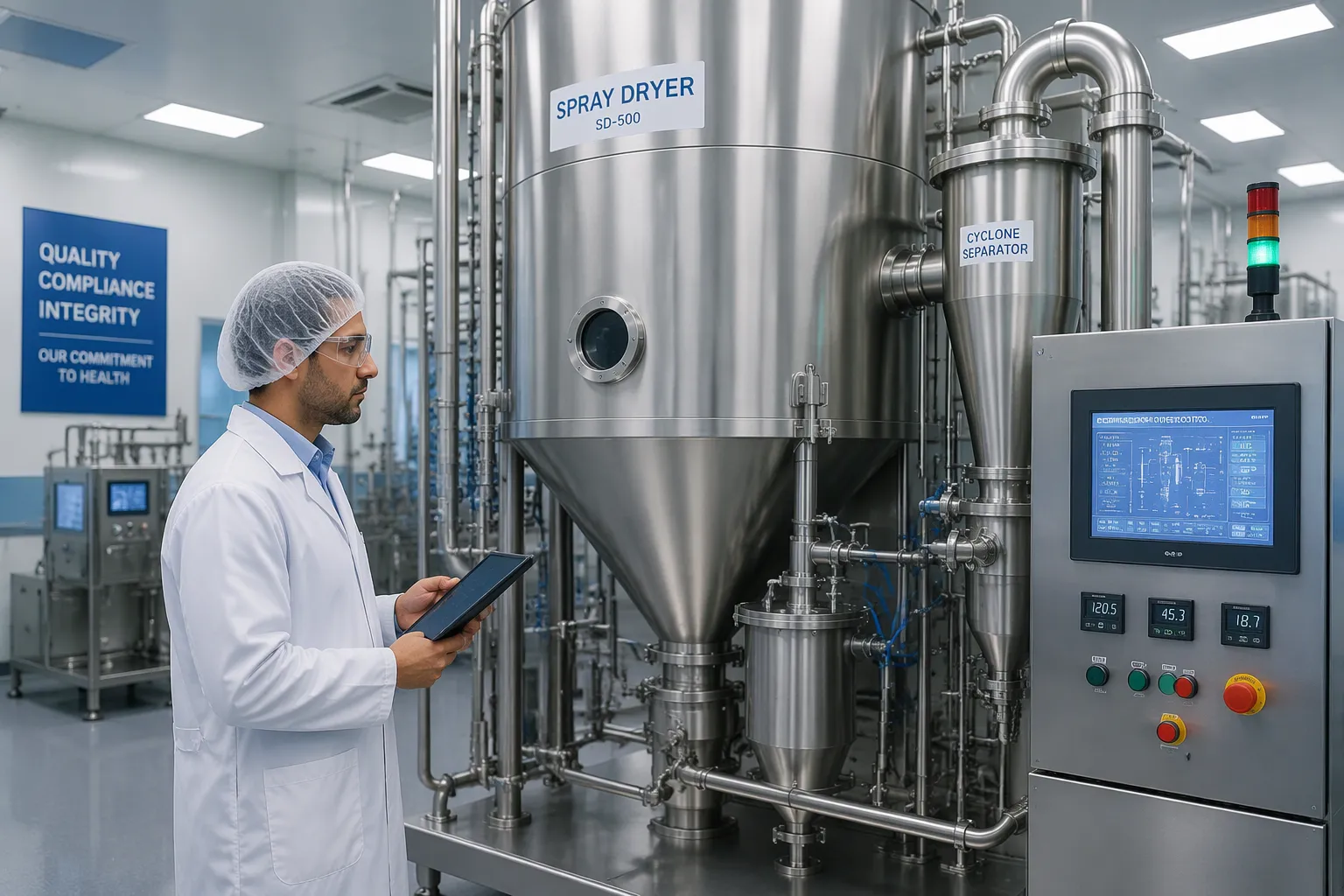
Choosing a pharmaceutical spray dryer depends on three main parts: process requirements, capacity, and system configuration. Process requirements include feed chemistry, the solvent system, and heat sensitivity. Capacity sets the evaporation rate the unit must deliver. Configuration sets the loop type, the sterility level, and the atomization approach.
Each part narrows down the machines that will work. A buyer who goes through them in order avoids paying too much for features they will not use. The sequence turns one purchase decision into a series of technical choices. Good spray drying selection starts here, not with a price sheet. This post goes through the three parts in order and ends with a practical equipment selection checklist.
Key Takeaways
Use three steps to pick a spray dryer: process needs, capacity, and system setup.
Choose the dryer size based on how much water it must evaporate, not on how much feed goes in. A feed of 1,000 kg/hr with 40% solids takes out about 583 kg/hr of water.
Pick a closed-loop system when you use flammable solvents. Water-based feeds can often use an open loop.
Test the spray dryer with your actual feed on a small scale before full production. This checks the design and lowers the risks.
Use a checklist to compare vendors in a fair way. This helps you avoid common mistakes and keep total cost under control.
Process Requirements for a Pharmaceutical Spray Dryer
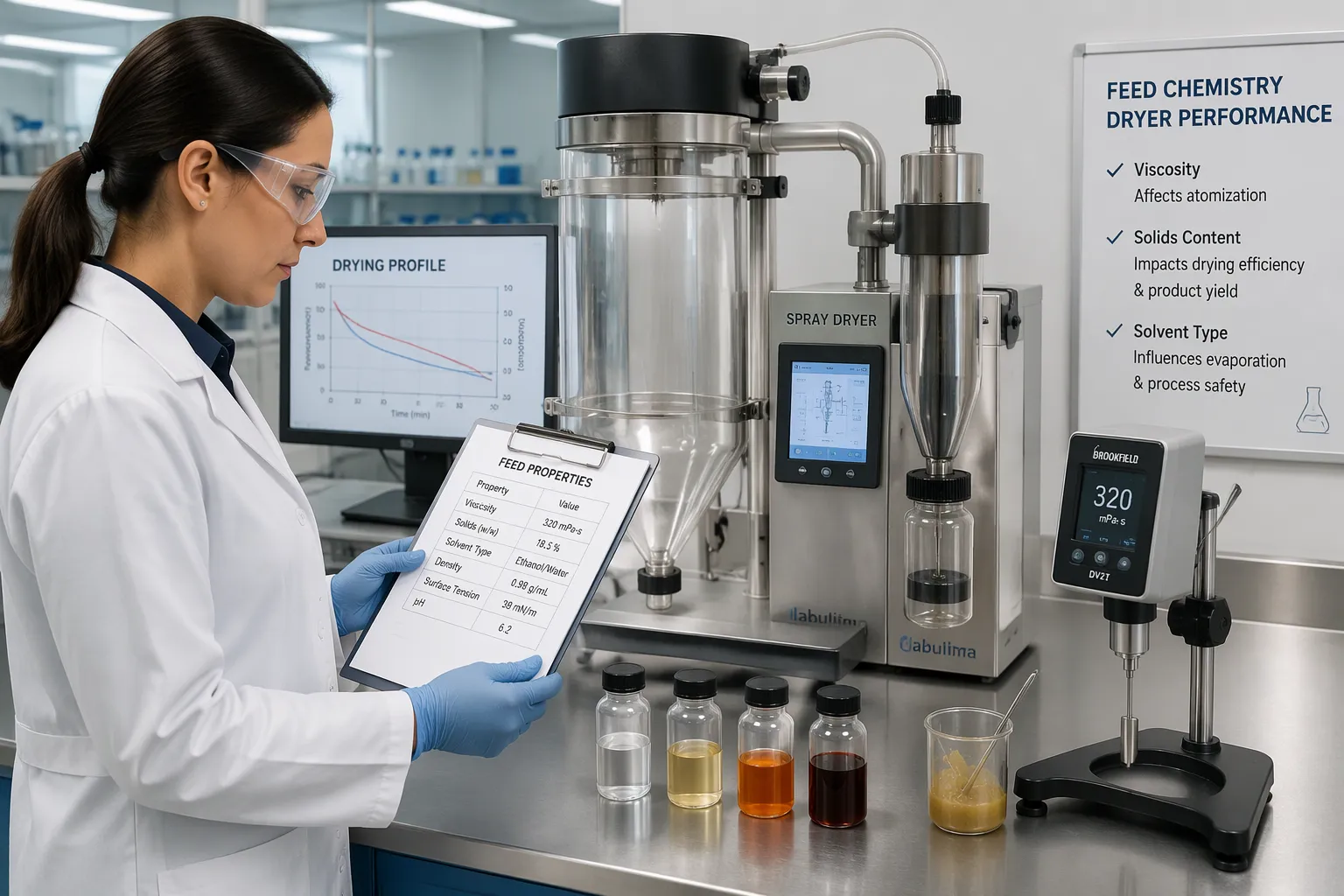
Feed chemistry, the solvent system, and heat sensitivity guide equipment selection more than capacity alone. A 100 kg/hr evaporation requirement means very little if the feed is sticky, solvent-based, or thermally sensitive, as spraydryer.com notes. Buyers who lock in the evaporation rate before studying the formulation often have to redo the design later. Process design should start with the liquid in the tank, not the powder bag.
Feed Chemistry and Formulation
The manufacturer needs a full picture of the feed before quoting a pharmaceutical spray dryer. Spraydryer.com lists the data that shapes the design: feed type, total solids percentage, viscosity, solvent type, heat sensitivity, final moisture target, particle size target, bulk density target, sterility expectation, batch or continuous operation, utility availability, and the scale-up plan. Each item changes a hardware decision. Total solids set the evaporation load and whether the run makes commercial sense. Viscosity affects pumping and atomization. The target final moisture drives the outlet temperature and the drying profile.
Liquid properties deserve close attention. Cyco Nozzles advises checking viscosity and flow behavior, surface tension, solid concentration, solvent composition, feed temperature, and suspended particle characteristics. The feed system and atomizer should match the actual formulation. No single nozzle design works for every liquid.
Spray dryer applications in pharmaceuticals cover API drying, traditional Chinese medicine extracts, and preparation granulation. These are not the same job. A water-based herbal extract, a solvent-based API formulation, and a heat-sensitive enzyme feed may all carry the same label. They may still need different atomization, chamber sizing, air handling, filtration, and powder collection logic. A water-based extract and a solvent-based API formulation also differ in loop choice, which the next section covers.
Heat Sensitivity and Solvent System
Heat sensitivity sets the temperature window. Shpilotech recommends adjusting the inlet and outlet temperatures to the material's heat sensitivity and activity test results. The outlet temperature must be tied to product sensitivity and final moisture, which keeps the powder at the proper final moisture. Co-current airflow is common in pharmaceutical spray drying because the product meets the hottest air while its moisture content is highest. That exposure cools the droplet quickly. For very sensitive APIs, low-temperature spray drying is an option.
The solvent system decides the loop and the safety scope. Water-based feeds can usually run in an open-cycle system when the material and process allow it. Solvent-based pharmaceutical feeds need early closed-loop evaluation. Ethanol, acetone, and ethyl acetate bring flammability and recovery requirements. A late decision on the loop creates safety, layout, and utility problems. Mixtures of water and organic solvents add another layer. Evaporation rates differ, vapor composition shifts during the run, and the condenser must handle the load.
Residual solvent limits tie the drying profile to the final moisture. The ICH guideline sets acetone below 0.5% by weight and methanol at no more than 0.3% by weight. THF and DCM limits are even lower. These limits, together with the final moisture target, constrain the outlet temperature and residence time. A number copied from another product can create quality issues. Spray-dried dispersions of API and polymer in acetone, methanol, THF, or DCM are a common case, and they reward a design built around the real solvent.
Spray Dryer Applications in Pharmaceuticals
Spray dryer uses in pharmaceuticals cover many feed types and powder goals. API processing, herbal extract conversion, and enzyme processing each put different demands on the same equipment platform. A typical spray drying system has a feeding system, an atomizer, a drying chamber, a cyclone separator, and a powder collection stage. Each part must fit the application, not just the plant's throughput target.
Atomization and Nozzle Design
In spray dryer uses in pharmaceuticals, the atomizer choice follows the feed and the powder goal. Rotary atomizers suit many slurry and extract feeds. Pressure nozzles push feed through an orifice under high pressure and suit stable, pumpable liquids. Two-fluid nozzles use compressed gas to shear the liquid and handle viscous feeds or very fine powder goals. Sinothermo notes that two-fluid atomization is often the right starting point for pharmaceutical fine powders or inhalation products.
Droplet size drives drying kinetics and the final powder. Higher surface tension, viscosity, and density usually lead to larger average droplets, according to Pulsedry. Controlled, repeatable atomization matters in pharmaceutical spray drying because small changes affect quality and documentation, as Spraying Systems notes. The selection should match the atomizer to the feed, then confirm the choice in a trial.
Matching Process to Application
Spray dryer uses in pharmaceuticals each carry their own engineering point to check. API intermediate drying demands attention to heat sensitivity, the solvent system, residual moisture, and powder recovery. Herbal extracts bring stickiness and wall deposition concerns. Enzymes and proteins need tight control of product temperature, outlet temperature, and residence time. Spray-dried dispersions depend on the feed formulation and solvent removal. Sterile powder production adds HEPA filtration, sterile micro filtration, cleanability, and validation scope.
The outlet temperature often matters more than the inlet for product exposure and final moisture. Target particle size and final moisture guide the atomizer and drying profile together. Buyers should confirm feed solids, viscosity, carrier requirement, and maximum product temperature before fixing the configuration.
Capacity and Evaporation Rate
Capacity is the number people misread most often in a spray dryer quote. A unit rated at 1,000 kg/hr feed does not make 1,000 kg/hr of powder. Spraydryer.com explains that the dryer is sized mainly by water evaporation rate, heat load, airflow, and drying kinetics. The powder output is always smaller than the feed because the water leaves as vapor.
Calculating Evaporation Rate
The dry solids balance gives the real duty. Spraydryer.com walks through a feed of 1,000 kg/hr at 40% solids with a 4% final moisture target. Dry solids equal 1,000 times 0.40, or 400 kg/hr. Product powder equals 400 divided by 0.96, or 416.7 kg/hr. Water evaporation equals 1,000 minus 416.7, or 583.3 kg/hr. The buyer should talk about this project as roughly 583 kg/hr of evaporation duty, not as a 1,000 kg/hr machine.
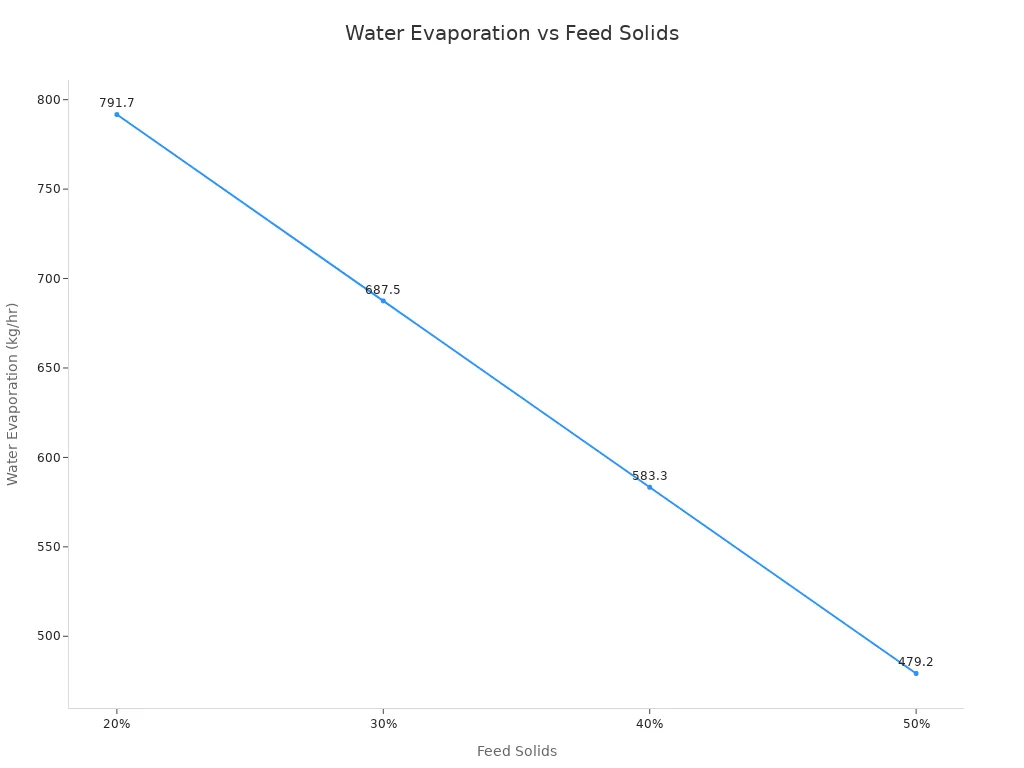
That evaporation figure then sets the thermal energy, the drying air volume, the hot air generator size, and the exhaust load on the cyclone and bag filter. A higher feed solids percentage lowers the evaporation load. Spraydryer.com shows that raising solids from 20% to 50% at the same feed rate cuts water evaporation from 791.7 kg/hr to 479.2 kg/hr. The chart from spraydryer.com shows this drop as feed solids rise.
Pilot to Commercial Scale-Up
Established scale-up rules move process parameters from pilot to production. AP Dynamics describes a sequence of define, develop, validate, scale up, confirm, and implement. Its dryers are built so that temperature, airflow, feed rate, and atomization settings carry over from the small unit to the larger one with little adjustment. That tight calibration cuts down on long revalidation.
Moisture control is the hardest parameter to hold across scales. AP Dynamics notes that uneven airflow patterns change droplet drying and create inconsistent moisture distribution. The outlet temperature is the strongest sign of final moisture and thermal exposure. A steady outlet temperature, feed rate, and solids level keep the final moisture in range.
Shinma supports this work with a clean laboratory for process verification and optimization. The company has delivered thousands of spray drying units, including closed loop spray dryer systems, so its scale-up data covers many feed types. A pilot trial on representative feed is still the soundest path to a full-scale pharmaceutical spray dryer.
Selecting a Pharmaceutical Spray Dryer Configuration
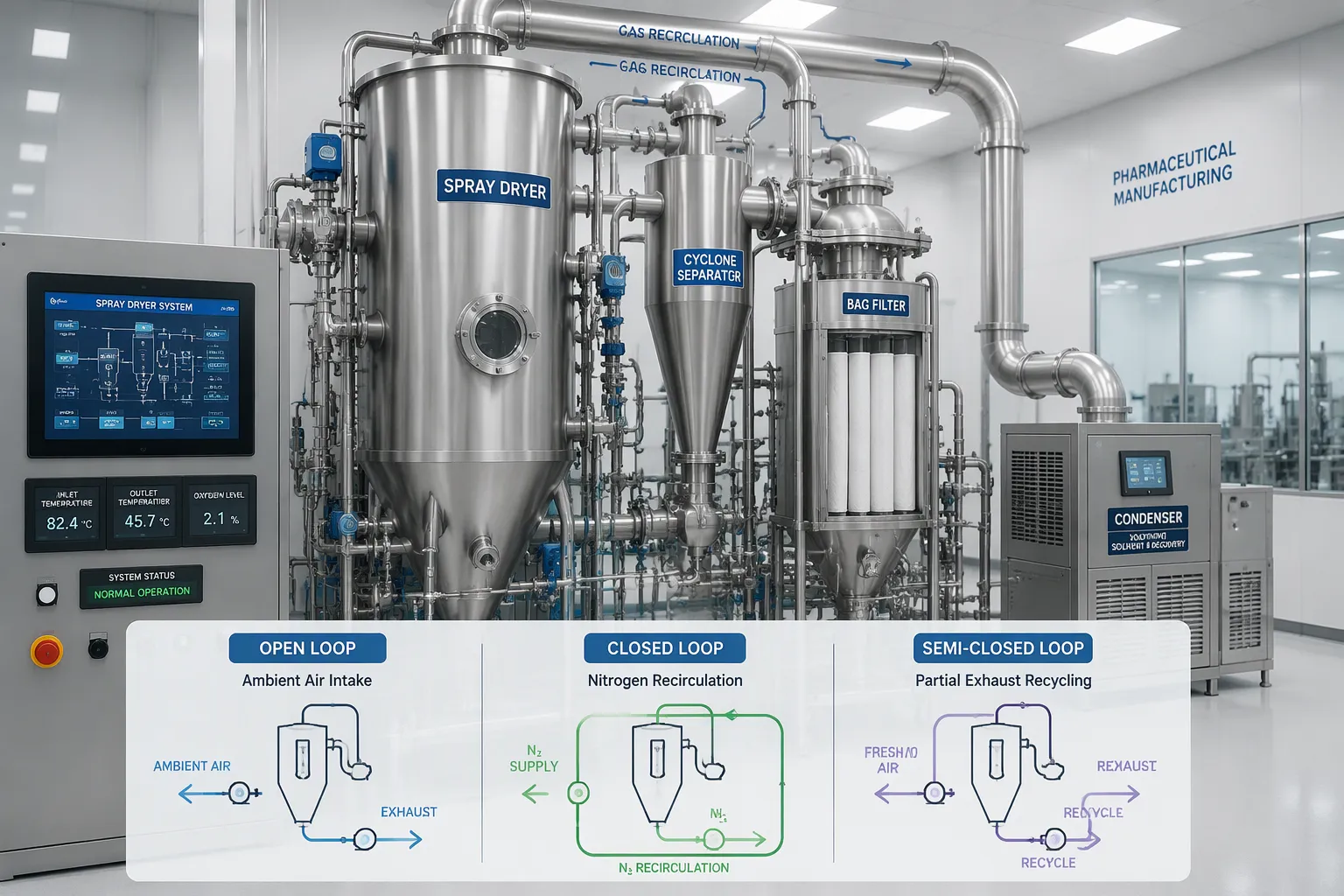
The system layout comes after the process work. The solvent, the sterility target, and the atomization choice narrow the field to five families: open, closed, semi-closed, sterile, and pilot units. Each family fits a defined job, and the selection should start here.
Open, Closed, and Semi-Closed Loops
Akshengineering compares the two main loops on several factors. Open loops pull in ambient air once, remove water, and vent the exhaust after cleaning. They cost less, use simpler utilities, and suit water-based feeds that are safe in air. Closed loops recirculate nitrogen or another inert gas, remove organic solvents, and recover vapor through a condenser. They need nitrogen, chilled water or brine, and oxygen monitoring, so capital cost and operating complexity run higher.
Factor | Open Loop | Closed Loop |
|---|---|---|
Drying medium | Ambient air, single pass | Inert gas, recirculated |
Liquid removed | Water | Organic solvents |
Solvent recovery | Not usually | Yes, via condenser |
Capital cost | Lower | Higher |
Semi-closed systems send part of the exhaust back to the heater. Recycling raises humidity and lowers oxygen content, and it can recover some exhaust heat. Akshengineering notes this approach suits products that need reduced oxygen without solvent recovery. It is not a substitute for a true closed loop spray dryer when flammable solvents are present.
Solvent-based pharmaceutical feeds usually call for a closed loop spray dryer, both for safety and to recover solvent. A closed loop spray dryer also protects operators from potent compounds. A pharmaceutical spray dryer built for water service will not convert to solvent duty without a new gas train and safety scope. The High Speed Centrifugal Sprayer Dryer from Shinma handles heat-sensitive materials and offers customizable closed-cycle, open-cycle, and semi-closed systems. Buyers weighing pharmaceutical spray dryer configurations should treat the loop as the first configuration decision. Heat sensitivity and capacity come next, and both depend on this choice.
Sterile Design and Centrifugal Atomization
Sterile powder processing adds HEPA filters and sterile micro filters to the drying air path, per spraydryer.com. Powder contact surfaces use 316L stainless steel, and the chamber finish must verify at Ra ≤ 0.8 µm to limit sticking, according to Shinma. Clean-in-place and sterilize-in-place systems support validated cleaning; Shinma specifies steam at ≥121°C for at least 20 minutes. The containment requirement grows with potency, so high-potency APIs need sealed systems with clean-in-place features.
Centrifugal atomization throws feed outward from a high-speed disc. ACMEFIL rotary disc units produce droplets in the 20 to 75 micron range, which supports droplet size control. Shpilotech notes atomized droplets usually fall between 10 and 100 μm, and the brief hot-air exposure limits damage to heat-sensitive material. A short residence time helps hold the outlet temperature steady and keeps final moisture on target.
Pharmaceutical spray drying systems divide into cleaning zones and run by PLC control with minimal manual operation. PLC recipes, alarms, and data logging keep the outlet temperature and final moisture repeatable across batches. That automation matters for sterile powder processing, where batch records must stand up to review. Spray dryer applications in pharmaceuticals range from API drying to spray-dried dispersions, and every spray drying run rewards a loop built around its real solvent.
Equipment Selection Checklist
A repeatable framework keeps vendor comparisons fair. The buyer checklist below follows the sequence from spraydryer.com and turns it into a working document for any pharmaceutical spray dryer project.
Step-by-Step Decision Guide
Define the powder target: final moisture, particle size, bulk density, flowability, and heat sensitivity.
Characterize the feed: solids content, viscosity, pH, solvent presence, and filtration needs.
Choose the atomization route: rotary, pressure nozzle, or two-fluid.
Select the configuration: standard, closed loop spray dryer, sterile, or pilot unit.
Check the heating method against contamination risk and utility supply.
Estimate the evaporation load, which sets spray dryer capacity.
Run pilot testing on real feed where risk is high.
Plan powder recovery and exhaust handling.
Compare lifecycle support: installation, training, spares, and service.
Finalize technical scope before any price comparison.
This buyer checklist works for full-scale equipment selection and for pilot units alike. The selection sequence matters because a pharmaceutical spray dryer RFQ should carry every answer. A price without feed data is not a design quote, as spraydryer.com notes.
Common Pitfalls to Avoid
Alaqua Inc. lists five mistakes that keep showing up across spray dryer applications in pharmaceuticals. Buyers misjudge production needs, ignore quality and efficiency, overlook maintenance and operating costs, neglect technical support, and fail to plan for expansion. Each one raises total cost after installation.
Loop choice brings its own traps. Spraydryer.com warns against choosing an open cycle just because the feed "only has some solvent." Vapor concentration and flash point decide the safety case, not a casual percentage. The same source cautions against treating heat sensitivity as an automatic closed loop requirement. Correct outlet temperature, residence time, and airflow often handle water-based sensitive products. A steady outlet temperature also protects final moisture across spray drying runs. Finally, buyers should confirm final moisture targets and separation design before signing, since a weak cyclone or bag filter loses powder in either loop.
The three-part approach keeps a pharmaceutical spray dryer project on track. Teams first define process requirements, then size capacity by evaporation rate against real production needs, and then choose the configuration that fits solvent, sterility, and atomization demands. The buyer checklist turns that order into a repeatable framework for comparing vendors and quotes.
Regulatory compliance belongs in the same conversation. FDA and EMA expectations, Quality by Design documentation, and ICH stability data all shape the final selection. Total cost matters too. Pulsedry notes that the purchase price is only part of the investment, and maintenance, utilities, and consumables drive lifetime economics. A well-matched pharmaceutical spray dryer balances technical performance, compliance, and total cost.
FAQ
How does a buyer size a pharmaceutical spray dryer?
Size the unit by evaporation rate, not powder output. A feed of 1,000 kg/hr at 40% solids with a 4% final moisture target removes about 583 kg/hr of water. That evaporation number sets the heat load, airflow, and exhaust duty.
When does a feed require a closed-loop configuration?
Flammable solvents call for a closed loop. Vapor concentration and flash point decide the safety case, not a casual solvent percentage. Closed loops recirculate inert gas and recover vapor through a condenser. Water-based feeds can often run in an open loop when the material allows it.
Why does pilot testing matter before full-scale spray drying?
Pilot trials confirm atomization, drying kinetics, and powder recovery on real feed. Moisture control is the hardest parameter to hold across scales. A steady outlet temperature, feed rate, and solids level keep final moisture in range. Shinma's clean laboratory supports this verification work.
What does sterile spray drying add to the system?
Sterile designs add HEPA filters and sterile micro filters to the drying air path. Powder contact surfaces use 316L stainless steel, and the chamber finish verifies at Ra ≤ 0.8 µm. Clean-in-place and sterilize-in-place systems support validated cleaning, with steam at ≥121°C for at least 20 minutes.
Can one unit handle both heat-sensitive APIs and herbal extracts?
Often yes, with the right atomization and loop. Rotary atomizers produce droplets in the 20 to 75 micron range, and short hot-air exposure limits thermal damage. Each feed still needs its own trial. Selection should follow the formulation, not a generic platform claim.

