Spray Dryers for Fruit Powder Production
 Sep 23, 2026|
 View:6
Spray dryers for fruit powder production, also called powder spray dryers, turn liquid fruit juice, puree, or extract into dry powder. They do this by spraying the liquid into a heated chamber. This fast spray drying method works well for fruit powder spray dryer uses. It removes water in seconds with low heat. This keeps color, flavor, and nutrients. For example, spray-dried strawberry powder keeps 76% anthocyanins. Vitamin C retention reaches 87% at a 70°C outlet temperature. The chart below compares retention across methods.
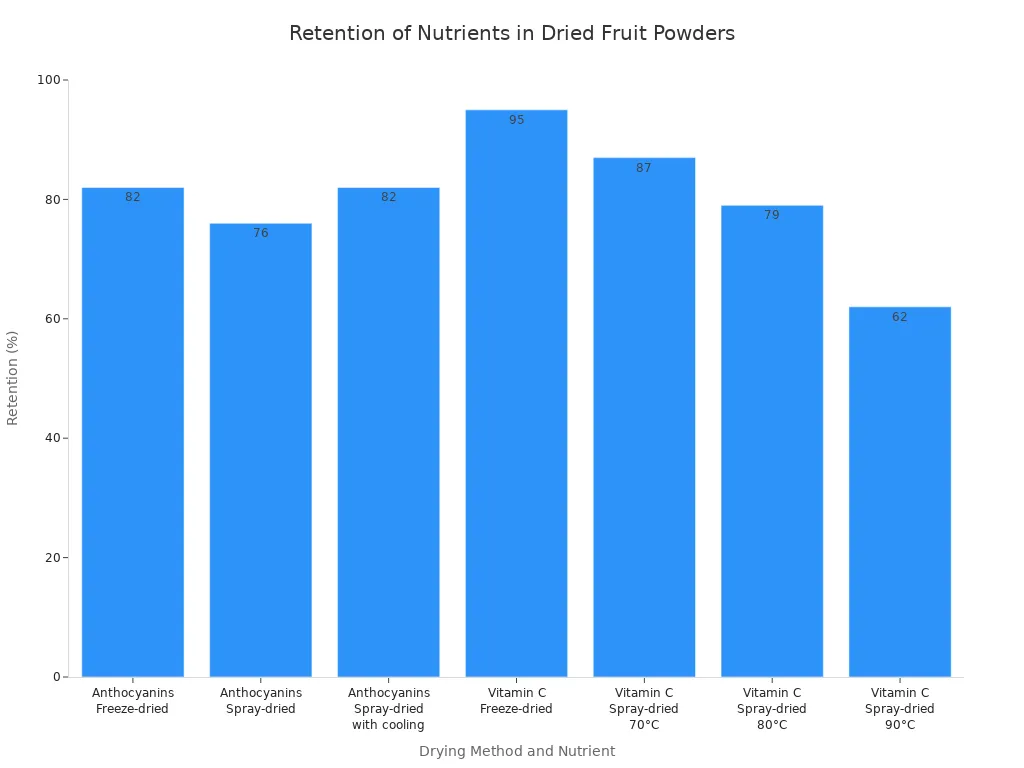
The production of fruit powders makes up over 38.6% of the spray-dried food market in 2024. This sector is expected to grow at 6.33% CAGR through 2034. Good fruit powder processing depends on picking a powder spray dryer that solves problems. These problems include stickiness from high sugar content and feed consistency.
Key Takeaways
Spray dryers quickly turn fruit juice into powder, and they keep 87% of vitamin C.
High sugar fruits become sticky, so choose a dryer with anti-sticking features.
Pick the right spray method for your fruit mix to get the best powder.
Pick the right size spray dryer so you don't waste money or run into production issues.
Choose a certified spray dryer to make safe and even fruit powder.
How Spray Dryers Work for Fruit Powder Production
The Four-Stage Drying Process
A powder spray dryer works in four steps that happen one after another. First, an atomization system turns liquid feed into tiny droplets. The system uses high-speed spinning or pressure to break the liquid into a mist. How big the droplets are affects drying speed and the quality of the final powder.
Second, the tiny droplets go into the drying chamber. Hot air flows into the chamber at controlled temperatures. The droplets and air mix right away. This contact stage sets the base for fast moisture removal.
Parameter | Range tested in study |
|---|---|
Inlet air temperature (IAT) | 170, 180, 190, 200, 210 °C |
Aspirator blower capacity (ABC) | 40, 50, 60, 70, 80 % |
Feed pump capacity (FPC) | 9, 12, 15, 18, 21 % |
Feed total soluble solids (TSS) | 7.5 % |
Encapsulating material (maltodextrin) | 4, 6, 8, 10, 12 % |
Third, evaporation happens in seconds. The large surface area of the droplets lets water escape fast. This quick drying is what defines spray drying technology. The process removes water in a flash. Fourth, particle separation collects the dry powder. Cyclones or bag filters catch the finished product. The low-moisture powder leaves the drying chamber ready for packaging.
For spray drying fruit powders, operators adjust parameters with care. Inlet air temperature usually ranges from 120°C to 200°C. A narrow window of 150–180°C balances drying efficiency with nutrient retention. The outlet temperature, around 80–90°C, shows the final moisture content. The feed rate changes depending on the fruit's heat sensitivity and sugar content.
Inlet/outlet air temperature was lowered to 80/55°C as a consequence of decreased drying air humidity. For validation, conventional spray drying was also conducted at 180/80°C inlet/outlet air temperature.
Why Heat-Sensitive Fruit Benefits from Rapid Drying
Fruit materials hold delicate nutrients. Vitamins, antioxidants, and natural colors break down quickly under high heat. A fruit powder spray dryer fixes this problem. The drying cycle takes only seconds. Heat exposure stays minimal, which preserves these sensitive compounds.
The rapid process also limits oxidation. Spray-dried fruit powders keep bright colors and fresh flavors. A professional powder spray dryer stops sugars from caramelizing. This method makes stable fruit powders with low water activity. Such powders fight off microbial growth and have a longer shelf life.
Another advantage has to do with consistent particle quality. Centrifugal atomization creates uniform droplets. This powder spray dryer design ensures even drying and powder characteristics you can predict. Manufacturers can get specific particle sizes using a powder spray dryer.
The mix of speed, low temperature, and a controlled process makes spray drying perfect for fruit juice drying. This fruit powder spray drying method captures the essence of fresh fruit in a stable powder form.
Fruit Material Challenges in Spray Drying Fruit Powders
High Sugar Content and Stickiness
Fruit materials have high levels of small sugars like fructose and glucose. These sugars have low glass transition temperatures. Fructose has a glass transition temperature of only 14°C. Glucose has a glass transition temperature of 31°C. When a powder spray dryer runs at temperatures 10–20°C above these limits, the sugars turn from a glassy solid into a rubbery liquid. In this rubbery state, particles get sticky. They stick to the chamber walls. This wall buildup lowers yield. It can also cause the product to brown or burn.
Component | Glass Transition Temperature (Tg) | Sticky Point Threshold |
|---|---|---|
Fructose | 14°C | Tg + 10–20°C |
Glucose | 31°C | Tg + 10–20°C |
Manufacturers fix this problem with anti-sticking setups. A full tower air system brings cool air along the chamber walls. This keeps wall temperatures below the sticky point. Another common fix is adding maltodextrin to the feed. Maltodextrin raises the overall glass transition temperature. It lets spray drying run at higher inlet temperatures without stickiness. For fruit & vegetable powder production, picking a professional powder spray dryer with these features matters a lot. A fruit powder spray dryer with precise temperature control stops these stickiness problems.
Viscosity, Fiber, and Feed Consistency
Fruit purees and juices differ a lot in viscosity and fiber content. High-viscosity fruit and vegetable pulp needs special atomization systems. A standard nozzle may clog or make uneven droplets. This leads to powder quality that is not consistent. The atomization method must fit the feed characteristics. For thick pulps, a two-fluid nozzle or high-speed centrifugal atomizer works better.
Fiber content also changes drying behavior. Long fibers can bridge across nozzle openings. They break up the spray pattern. A spray dryer for vegetable powder must handle these challenges. The feed system needs proper pre-treatment. Some manufacturers pre-homogenize or enzymatically treat the feed. This lowers viscosity and breaks down fibers. During spray drying of vegetable materials, fiber content directly affects particle formation. A second spray dryer for vegetable powder setup uses a different atomizer design. This fixes fiber-related clogging issues well.
Feed consistency is another key factor. Changes in solids content alter droplet size and drying rate. A steady feed with controlled total soluble solids gives repeatable results. For fruit powders and fruit and vegetable powders, operators watch feed properties closely. Both fruit powders and fruit and vegetable powders need stable feed conditions. For spray drying applications, consistent feed properties stay essential. A well-designed powder spray dryer handles these material variations. A reliable powder spray dryer with proper feed handling produces consistent final quality.
Key Selection Criteria for Fruit Powder Spray Drying
Atomization Method and Temperature Control
The atomization system controls droplet size, powder evenness, and how a spray dryer works with different fruit materials. There are three main options, and each works best for specific feed types.
Centrifugal atomization uses a fast-spinning disc. It can handle high feed rates over 30,000 kg/h and thick feeds up to 30,000 cP. The particle size range is wider, with a spread of 1.5–2.5. This method is good for rough slurries and large-scale production. Centrifugal spray drying systems make round, fairly even particles.
Pressure nozzles give the narrowest particle size range, with a spread of 1.0–1.5. They work best for thin feeds below 300 cP. But they clog easily with mixtures and high-fiber purees. Two-fluid nozzles make the smallest droplets, with average sizes of 5–80 microns. They can handle thick pastes up to 50,000 cP, so they are great for tomato puree and fruit concentrates. For feeds over 1,000 cP, you must use a rotary or two-fluid nozzle.
Temperature control is also very important for heat-sensitive fruit powders. For most food, inlet air temperature is 160–220°C and outlet temperature is 80–100°C. Heat-sensitive materials need milder conditions: inlet 120–160°C and outlet 60–80°C. Keeping outlet temperature below 80°C helps keep 87% of vitamin C. Going above 85°C outlet causes over 60% loss of important flavor compounds. A spray dryer must keep these tight ranges to protect quality.
Shinma offers customizable setups to meet these needs. The LPG series uses centrifugal atomization for large-scale fruit processing. The YPG series uses pressure nozzles for thin feeds. The XLP closed-loop design handles oxygen-sensitive materials with inert gas cycles.
Anti-Sticking Design and Hygiene Standards
Fruit powders stick to drying chamber walls because of high sugar. Anti-sticking features fix this. A full tower air system sends cool air along chamber walls, keeping wall temperatures below the sticky point. Cold air jackets and anti-sticking wall structures stop coking and sticking. These features let a spray dryer run smoothly with sticky fruit materials.
Hygiene standards keep products safe. CE, ISO9001, and ISO14001 certifications show that a spray dryer meets international quality and environment rules. Food-grade stainless steel like SUS304 or SUS316L is used for all surfaces that touch products. EHEDG-aligned designs need polished surfaces with roughness at or below 0.8 µm, welds without gaps, and shapes that drain fully. These steps stop bacteria from growing and make cleaning easier.
A fruit powder spray dryer with good anti-sticking design and hygiene certification gives steady, safe output. The same ideas apply to a spray dryer for vegetable powder. A spray dryer for vegetable powder must deal with fiber and stickiness just as well. A spray dryer for vegetable powder with these features ensures high drying efficiency and product quality.
Picking the right powder spray dryer means matching atomization, temperature control, anti-sticking features, and hygiene standards to the fruit material. This method ensures success in spray drying technology for fruit powders.
Capacity Matching and Shinma Spray Dryer Models
Estimating Capacity from Feed Rate and Moisture
To size a powder spray dryer, first ask: how much water must come out of the feed each hour? The answer is the evaporation capacity. Operators find this using the liquid feed rate and the difference in moisture between the wet feed and the final fruit powders.
Water to Evaporate (kg/hr) = [Liquid Feed Rate (kg/hr) × (IMC – FMC)] / 100
Here, IMC is the initial moisture content (in %), and FMC is the final moisture content (in %).
For example, a fruit juice feed of 200 kg/hr with 85% initial moisture and 5% final moisture needs 160 kg/hr of water removal. That number guides the model choice. A powder spray dryer rated too low will run wet or clog. One rated too high wastes energy and space.
Evaporation capacity grows with machine size. Lab units handle about 5 kg/h. Pilot units cover 5–50 kg/h. Production units reach 50–200 kg/h and more. Matching the powder spray dryer to the real need keeps drying efficiency and product quality high.
Pilot-Scale vs. Industrial-Scale Models
Pilot and industrial spray dryers have different roles. A pilot unit tests the process, runs longer trials, and makes customer samples. It fits a pilot plant or a larger lab. An industrial spray dryer handles everyday commercial production. Its capacity starts at 50 kg/h and often goes into the hundreds or thousands of kg/h.
The capacity difference between pilot and industrial units is much bigger than between lab and pilot. Industrial units are sized for cost-effective production. Pilot systems usually cost between $50,000 and over $500,000, based on capacity, automation, and special features.
Shinma makes both ends of this range. The LPG-50 centrifugal model works well for large fruit and vegetable lines. The YPG-15 pressure nozzle unit is good for clean, low-viscosity feeds. The ZLPG-25 handles extract-based recipes. Prices range from $9,000 to $200,000. Shinma also provides custom solutions from lab-scale to industrial production.
For a fruit powder spray dryer, centrifugal atomization handles thick pulp up to about 30,000 cP. A spray dryer for vegetable powder with the same design resists clogging from fibrous feed. A spray dryer for vegetable powder that uses a pressure nozzle works better on thin, clean liquids. Buyers should match the atomizer to the feed, not the other way. A powder spray dryer chosen this way gives consistent output for both fruit powders and vegetable powders.
Common Mistakes and Applications in Fruit & Vegetable Powder Production
Mistakes to Avoid When Buying a Spray Dryer
Buyers often make expensive mistakes when they pick equipment for fruit powder production. One common error is choosing regular general-purpose dryers instead of professional fruit powder spray dryers. These machines do not have precise low-temperature control. They cause nutrient loss and powder that changes color. A proper fruit powder spray dryer protects sensitive compounds during fruit powder spray drying.
Another common error is not paying attention to anti-sticking design. Fruit materials with high sugar stick to dryer walls. This lowers yield and harms material quality. It also means frequent shutdowns for cleaning. A powder spray dryer without full tower air or cold wall jackets cannot handle sticky feeds well.
Capacity mismatch is a third big problem. A powder spray dryer that is too big wastes energy and raises investment cost. A unit that is too small limits production growth. It cannot meet growing market demand. Buyers should also check hygiene and certification standards. Equipment without food-grade materials and formal certification may fail factory inspection. This hurts sales and export business. A spray dryer for vegetable powder needs the same care with these details.
Fruit, Vegetable, and End-Product Applications
Spray drying technology works for a wide range of fruit and vegetable powders. Common fruit powders include apple, banana, mango, pomegranate, and strawberry. Vegetable powders cover tomato, carrot, beetroot, spinach, and garlic. These ingredients go into many end products. Instant beverages, health drink mixes, and smoothie blends use them a lot. Bakery, confectionery, and dessert premixes also depend on them. Dairy and plant-based formulations like yogurt, shakes, and ice cream mixes include these powders. Seasoning blends, soups, sauces, and fortified noodles benefit too.
A spray dryer for vegetable powder handles tomato and beetroot well. Manufacturers add maltodextrin to improve drying of sticky fruits. This helps produce high-quality natural fruit and vegetable powder.
Shinma has served thousands of enterprises around the world. The company supports food processing, pharmaceuticals, and chemicals. Its powder spray dryer lineup covers lab to industrial scale. For fruit & vegetable powder production, Shinma delivers reliable results. A well-chosen spray dryer for vegetable powder and fruit powder spray dryer ensures consistent output. These machines turn natural fruit and vegetable powders into profitable products.
Spray dryers for fruit powder work well. They dry fast and use low heat. Matching the dryer to the fruit's sugar and fiber is key. A fruit powder spray dryer needs good atomization and temperature control. Anti-sticking features and hygiene design also matter. A low-quality powder spray dryer causes wall buildup. It also leads to capacity problems. A smart choice protects fruit powders from heat damage. The same care applies to a spray dryer for vegetable powder. A well-chosen spray dryer for vegetable powder handles fibrous feeds without clogging. First, look at your production scale. Then, talk to a professional supplier like Shinma. This ensures success in spray drying.
FAQ
What makes spray dryers for fruit powder production different from standard dryers?
Standard dryers keep fruit in heat for a long time. Spray dryers for fruit powder production break liquid feed into tiny droplets. Hot air dries these droplets in seconds. This fast process saves color, flavor, and nutrients. The equipment also has anti-sticking features that handle high-sugar fruit materials without wall buildup.
How does a fruit powder spray dryer prevent stickiness from high sugar content?
Fructose and glucose have low glass transition temperatures. Particles turn sticky when chamber temperatures go above these limits. A fruit powder spray dryer uses full tower air systems. Cool air flows along chamber walls and keeps surface temperatures below the sticky point. Adding maltodextrin to the feed also raises the glass transition temperature.
Which atomization method works best for thick fruit purees?
Centrifugal atomization handles thick feeds up to 30,000 cP. Two-fluid nozzles manage pastes up to 50,000 cP. Pressure nozzles work best for thin liquids below 300 cP. For fruit powders made from high-fiber purees, centrifugal or two-fluid systems stop clogging. The choice depends on feed viscosity and the particle size you want.
What temperature range preserves nutrients during spray drying?
Heat-sensitive fruit materials need inlet temperatures of 120–160°C and outlet temperatures of 60–80°C. Keeping outlet temperature below 80°C retains 87% of vitamin C. Going above 85°C outlet temperature causes over 60% loss of flavor compounds. Precise temperature control is essential for quality fruit powders.
Can the same spray dryer for vegetable powder handle fruit materials?
A spray dryer for vegetable powder shares many design features with fruit processing equipment. Both need anti-sticking designs and hygiene certifications. However, vegetable powders often contain more fiber. This requires different atomizer configurations. Buyers should match the powder spray dryer to their specific material properties for consistent results.